
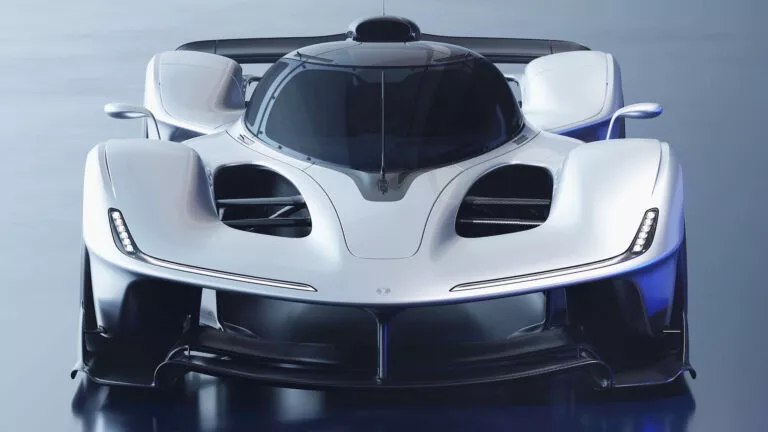
Red Bull’s RB17 Hypercar Changed Again And Now It’s Even More Unhinged
In the world of extreme performance cars, where Ferrari, Bugatti, Koenigsegg, and others battle for headline-grabbing benchmarks, Red Bull has quietly been building something wildly different: a track-only hypercar that isn’t just fast it’s a rolling manifesto for what happens when Formula 1 engineering goes absolutely no-compromise. That car is the RB17, and in its latest incarnation released in early January 2026 it’s evolved into what many are calling even more unhinged than before.
From F1 Factory Floor to Ultimate Track Toy
Red Bull Advanced Technologies the engineering arm of Red Bull that supports the Formula 1 team first teased the RB17 back in 2022 as a hypercar project that would push performance far beyond the bounds of road legality and regulatory constraint. Initially revealed in physical form at the Goodwood Festival of Speed in 2024, the RB17 was never meant to be a gentle supercar. Its mission was audacious: take everything learned through over two decades of Formula 1 dominance and shove it into a two-seat machine designed only for closed circuits.
Unlike many hypercars that must compromise to meet road-going safety and emissions rules, the RB17 escaped those constraints entirely and that freedom is what has led to one of the most radical evolutions ever seen in a performance car in development.
What’s New The 2026 RB17 Final Design
While earlier versions of the RB17 were already extreme, the latest update unveiled in the first week of January 2026 shows a car that looks more aerodynamic and aggressive than ever. The revisions are not superficial they represent a calculated evolution in philosophy and performance focus.
Aerodynamic Mayhem
The 2026 RB17 sports dramatic aerodynamic revisions that blur the line between car and racing prototype:
- Aggressive front splitter and reshaped LED lighting give the car a more purposeful, sinister stance.
- F1-style gills carved into the side pods improve airflow management and cooling at high speeds.
- A prominent roof-mounted shark fin enhances high-speed stability a feature more common in open-wheel racing than in hypercars.
- At the rear, a massive wraparound wing and enormous Venturi tunnels dominate the design, suggesting the car produces ground effect levels of downforce unheard of in non-regulation vehicles.
According to reports, the exhaust has even been rerouted to exit through the engine cover rather than beneath the diffuser a move that likely improves airflow and has significant implications for high-speed rear stability.
Heart of a Fighter: The RB17 Powertrain
The RB17’s engine is the stuff of legend. At its core lies a 4.5-liter naturally aspirated V10 developed in collaboration with Cosworth — a company with deep motorsport cred. This is not your typical road car V10.
Key Powertrain Highlights
- Naturally aspirated V10 that redlines at a staggering 15,000 rpm numbers usually reserved for Formula 1 engines.
- The gas engine delivers around 1,000 hp, while a supplemental 200 hp electric motor brings the total system output to roughly 1,200 hp.
- Combined with a remarkably light weight the car tips the scales at well below 900 kg this power puts the RB17 in rarefied territory usually limited to professional race cars.
- All that power is sent to the rear wheels via a bespoke six-speed sequential gearbox.
This setup produces some of the wildest performance figures ever attempted outside of Formula 1: F1-like lap times and a top speed exceeding 350 km/h, despite the absence of road legal requirements.
Design Philosophy: Formula 1 Without Restriction
What truly separates the RB17 from anything else on four wheels is how it was engineered. Almost every aspect of the car has been influenced by Red Bull’s Formula 1 expertise.
F1-Derived Engineering
- A carbon fiber monocoque chassis inspired by F1 composite techniques provides supreme rigidity and remarkably low weight.
- Pushrod suspension with adjustable dampers allows handling that would embarrass many professional race machines.
- Advanced ground-effect aerodynamics including side skirts and diffusers generate enormous downforce, something normally banned in F1 but embraced here.
- Michelin developed bespoke slick tires for the RB17 to optimize grip and handling at extreme speeds.
The RB17 isn’t just borrowing F1 technology it’s adapting it for a world where aerodynamic performance isn’t hamstrung by racing regulations or emissions requirements. That’s why enthusiasts, engineers, and journalists alike call the latest design “unchained” or “even more unhinged.”
Limited Production, Exclusive Ownership
Production of the RB17 will be extremely limited only 50 units worldwide making it one of the rarest hypercars ever created. Early reports suggest pricing starting around $6.7 million or more, depending on customization.
What makes the RB17 particularly unique beyond its extreme performance is the level of personalization. Red Bull has emphasized that buyers can tailor nearly every aspect from exterior finishes to interior materials ensuring that no two cars are exactly alike.
Owners will also be part of a special track program, with exclusive events, simulator sessions, and opportunities to experience the car on iconic circuits around the world.
Comparison: RB17 vs. Hypercar Rivals
In a market where hypercars from Ferrari, Lamborghini, Pagani, and Bugatti push the envelope of speed and technology, the RB17 stands apart not just in figures, but in philosophy. Most hypercars must still meet some regulatory or homologation standards be it emissions, interior safety, or road use.
The RB17 does none of that. Its sole purpose is performance not comfort, not compliance, not compromise. This is why traditional metrics like how fast it is on public roads barely matter here. What’s measured is downforce, lap times, and raw physics. Compared to other modern hypercars, the RB17 brings:
- A higher redline and freer powertrain design than most competitors.
- Aerodynamics that prioritize lap performance over aesthetics or cooling for emissions compliance.
- An engineering pedigree rooted in elite motorsport, rather than road car lineage.
The Legacy of Adrian Newey’s Final Project
Perhaps the most compelling part of the RB17 story is that this may be Adrian Newey’s last major design for Red Bull. Newey, the legendary aerodynamicist behind numerous F1 championship cars, left Red Bull to join Aston Martin in 2025 but stayed through the RB17’s completion. His fingerprints are all over this machine and now, with the final design released, we may be seeing the true distillation of his boundless creativity unleashed without rulebooks or regulations.
Conclusion: More Than A Car A Statement
The 2026 RB17 hypercar isn’t just another exotic machine. It’s a statement about what happens when the boundaries between racing technology and track-only performance are erased. It’s a car that challenges assumptions about speed, aerodynamics, power delivery, and what a hypercar can be when it’s allowed to break every rule except physics.
Described by many as unhinged, insane, and the closest thing to a Formula 1 car for the public, the RB17 is now more extreme than ever a fitting capstone to an era of motorsport engineering and a tantalizing glimpse of what lies beyond traditional car design.









Leave a Reply